
NYC Minimum Wage and Salary Requirements: What Small Business Owners Need to Know
Hiring employees is an exciting milestone for any growing business. However, understanding NYC minimum wage and salary requirements is critical to staying compliant and avoiding costly penalties. While many business owners are familiar with minimum wage laws, fewer understand the salary requirements that determine whether an employee can legally be classified as salaried and exempt from overtime.
Let’s break down the key requirements every NYC employer should know .
NYC minimum Wage Requirements 2026
For businesses operating in New York City, the minimum wage for most hourly employees is $17.00 per hour in 2026.
Employers must ensure that every employee receives at least this minimum amount for all hours worked. Failure to comply can result in back wages, penalties, and potential legal action.
NYC minimum Wage thresholds for Tipped Employees
Businesses that employ tipped workers have different wage requirements depending on the industry. Service Industry Employees
If you operate a service-based business such as a hair salon, spa, or similar establishment, tipped employees must receive:
- Minimum direct wage: $14.15 per hour
- Maximum tip credit: $2.85 per hour
The combination of wages and tips must equal at least $17.00 per hour.
For restaurants and food service businesses there is a different minimal wage:
- Minimum direct wage: $11.35 per hour
- Maximum tip credit: $5.65 per hour
Again, the employee’s combined wages and tips must equal at least $17.00 per hour.
If tips do not bring employees up to the required minimum wage, the employer must make up the difference.
NYC minimum Wage Also Applies To Salaries
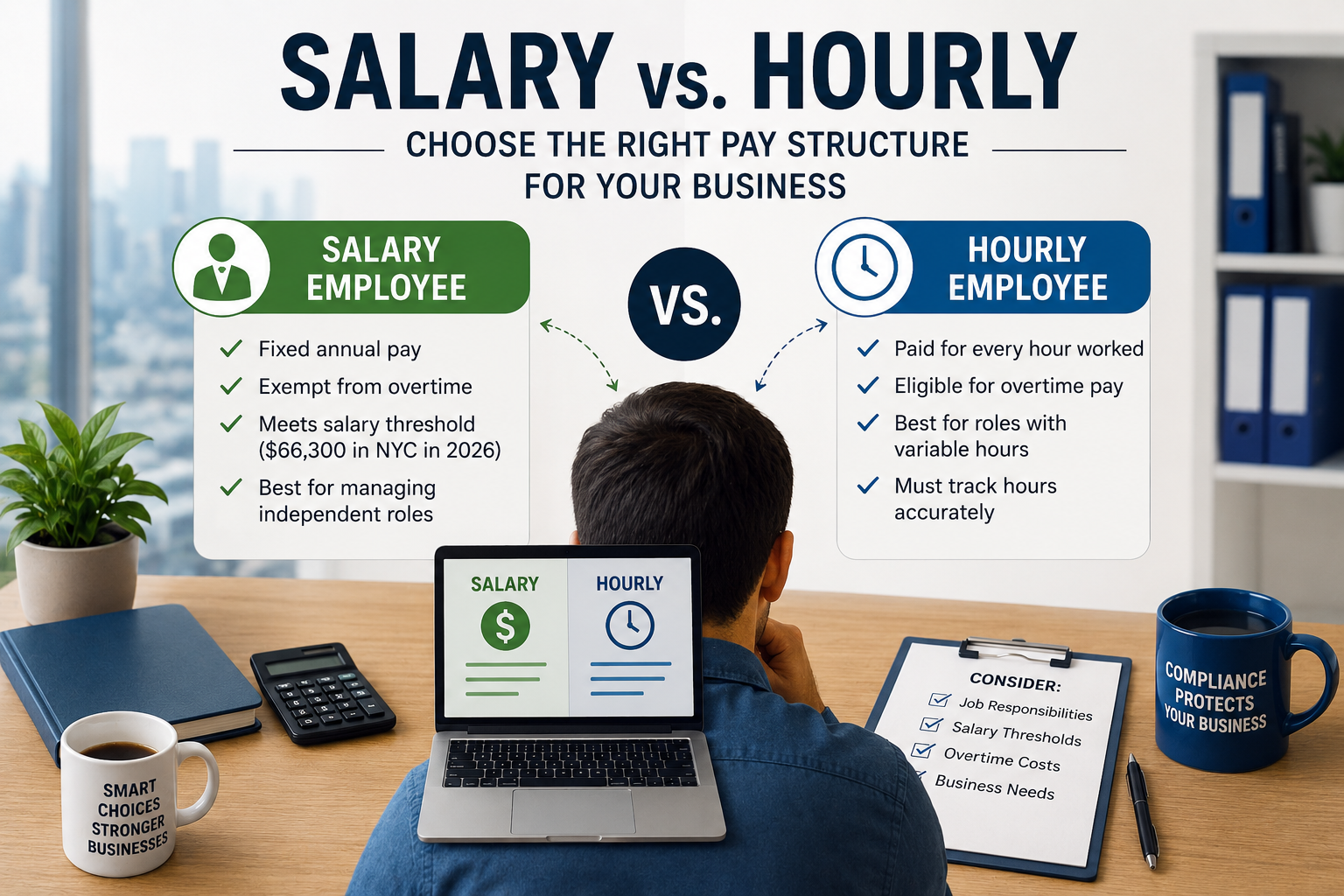
One of the most commonly misunderstood aspects of payroll compliance is the minimum salary threshold for salaried employees. In New York City, the minimum salary requirement for exempt salaried employees is $66.300 for 2026.
This threshold determines whether an employee may qualify for certain overtime exemptions. If an employee earns less than $66,300 annually, simply paying them a salary does not automatically make them exempt from overtime requirements.
Understanding Salaried vs. Hourly Employees
Many business owners assume that paying someone a salary eliminates overtime obligations. Unfortunately, that’s not always the case.
Under New York minimum wage and salary requirements 2026, employees earning below the salary threshold generally should be classified as hourly workers and paid overtime when applicable.
For example: A business hires a project coordinator at $55,000 per year. Since $55,000 falls below the required salary threshold of $66,300, the employee may need to be classified as nonexempt and paid on an hourly basis.
This means:
- Tracking hours worked
- Paying overtime for hours exceeding 40 per week
- Maintaining accurate payroll records
NYC Minimum Wage and Salary Requirements: How Overtime Impacts Your Payroll Costs
When converting a position from salaried to hourly, employers should evaluate the potential impact of overtime costs.
For example, a $55,000 annual salary can be converted into an equivalent hourly wage based on a standard 40-hour workweek. If that employee regularly works overtime, total compensation may increase.
However, this approach often provides greater legal protection and compliance than incorrectly classifying an employee as exempt. The cost for getting this wrong includes:
- Back wage payments
- Interest charges
- Civil penalties
- Employee lawsuits
- Legal defense costs
- State investigations
Even unintentional mistakes can become expensive if payroll classifications are not handled correctly.
How Small Business Owners Can Stay Compliant
To reduce risk and protect your business:
Stay Up To Date – Starting in 2027, the minimum wage will be tied to inflation, and increase based on a three-year average of the Consumer Price Index for the Northeast. The planned annual increases may be affected by certain economic and budget conditions. Here is the NY DOL Minimum Wage Page
Review Employee Classifications – Ensure each worker is properly classified as either exempt salaried or nonexempt hourly.
Verify Salary Thresholds – Confirm that salaried employees meet the required minimum salary level.
Monitor Overtime Hours – Track employee hours accurately and pay overtime when required.
Maintain Payroll Documentation – Keep detailed payroll records in case questions arise during an audit or investigation.
Final Thoughts on NYC Minimum Wage and Salary Requirements
Understanding New York minimum wage and salary requirements is essential for every small business owner. While minimum wage rates often receive the most attention, salary thresholds and employee classifications can create even greater compliance risks.
Before hiring or restructuring employee compensation, take the time to review wage requirements, salary thresholds, and overtime obligations. A proactive approach today can save your business significant time, money, and legal headaches tomorrow.
If you want to Learn the top 3 financial and compliance challenges NYC business owners face and the simple strategies to sidestep them like a pro, we have you covered. Click here to access our Free NYC Business Guide.