
New York ECEP: What S-Corp Owners should do by December 1
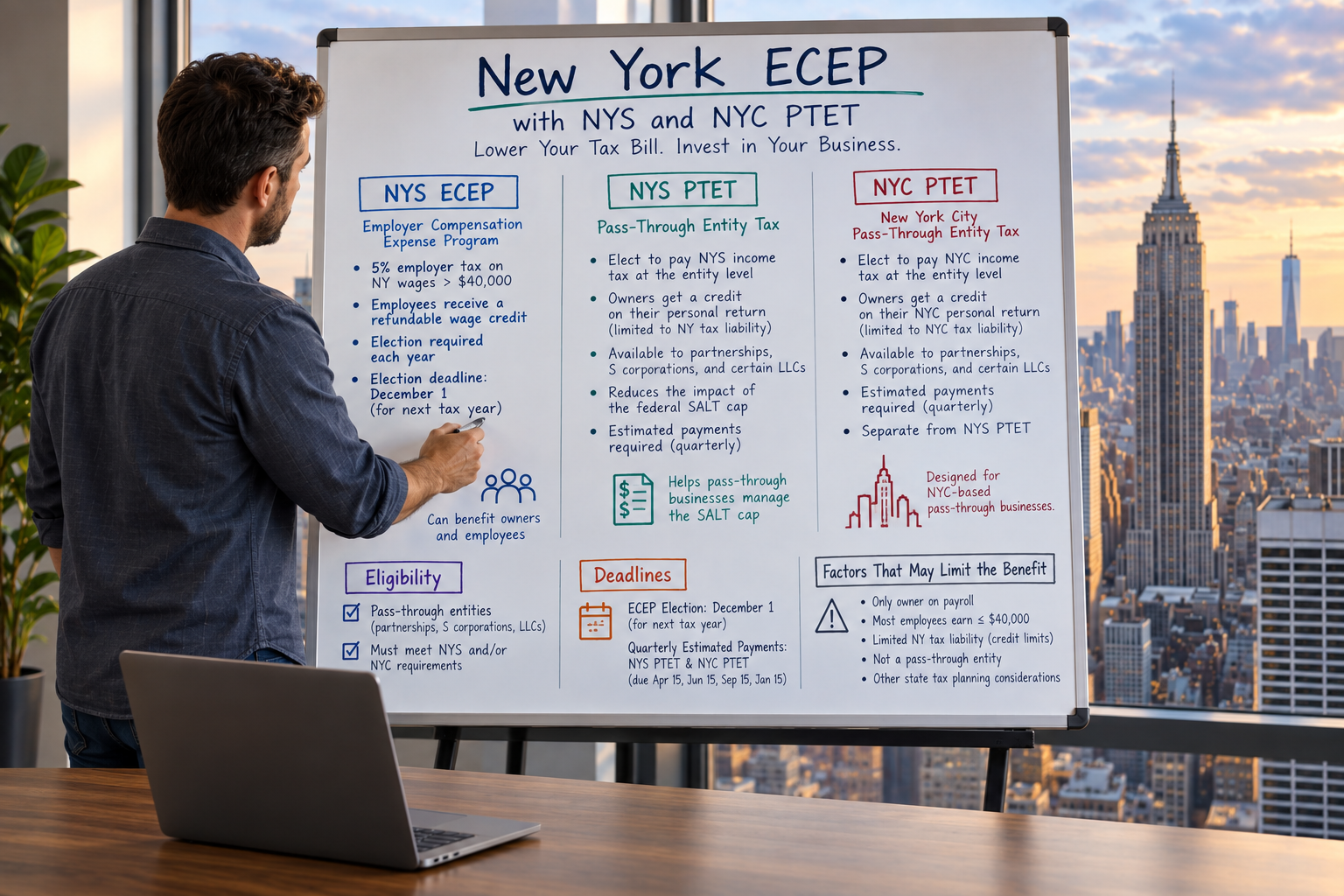
We love being in New York, but running a business here can be complicated. The New York ECEP is a good example: the election is made by the employer, the tax is paid through the business, and the related credit appears on an employee’s personal New York return. You have to look at all three pieces together.
Enrollment for the 2027 New York ECEP opens October 1, 2026. Employers that want to participate must make an affirmative election by December 1, 2026. That does not mean every eligible business should automatically renew or enroll.
ECEP was created as a workaround to the federal limit on deducting state and local taxes. Since the federal SALT deduction rules have changed, the program may provide less value to some business owners than it did under the former $10,000 limit. The right answer depends on the business, the employees being covered, the owner’s federal, New York State, and New York City tax position, and the cost of the additional payroll filings.
How Does New York ECEP Differ From NYS and NYC PTET?
ECEP, New York State PTET, and New York City PTET are 3 different elective taxes that may help you reduce your overall taxes once you have hit your SALT deduction cap. But they are not interchangeable and each have deadlines, rules and their place in managing your tax liability.
| Issue | ECEP | NYS PTET | NYC PTET |
|---|---|---|---|
| Who elects? | An employer | An eligible pass-through entity | An eligible city partnership or city resident New York S corporation |
| What creates the tax? | Covered New York employee wages above $40,000 | Pass-through income allocated under the state PTET rules | Pass-through income attributable to eligible NYC-resident owners |
| Tax rate | 5% of covered wages above $40,000 | Graduated rates under the NYS PTET rules | 3.876% of NYC PTE taxable income |
| Who may receive the related credit? | A qualifying employee | An eligible direct partner, member, or shareholder | An eligible direct partner, member, or shareholder subject to NYC personal income tax |
| How is the individual credit treated? | Nonrefundable; unused credit may carry forward | Claimed under the NYS PTET credit rules | Equal to the owner’s direct share of NYC PTET; an excess is treated as an overpayment that may be credited or refunded |
| Where is the tax paid? | Through separate employer payroll-related filings | Through the entity’s PTET account and annual return | Through the same online system and return used for NYS PTET |
| Election deadline | December 1 of the preceding year | Generally March 15 of the tax year | Generally March 15 of the tax year, together with the NYS PTET election |
| Is it limited to owners? | No | The credit generally relates to eligible owners | Yes; the credit relates to eligible NYC-resident owners |
PTET generally applies to qualifying business income passed through to owners. ECEP applies to employee compensation, which can include wages paid to an owner who is also an employee. An S corporation owner may therefore have three questions on the table:
1 – whether the entity should elect NYS PTET for pass-through profit,
2 – whether it is eligible for NYC PTET, and
2 – whether the employer should elect ECEP for covered wages. Each election requires a separate calculation.
New York ECEP Details
The Employer Compensation Expense Program, or ECEP, is an optional New York State program. An employer electing into the program pays the Employer Compensation Expense Tax, commonly called ECET, on certain New York wages.
For 2027, the tax rate is 5% of each covered employee’s New York wages and compensation exceeding $40,000 for the calendar year.
For example, if a covered employee earns $100,000 of qualifying New York wages, the employer’s tentative ECET would be:
($100,000 − $40,000) × 5% = $3,000
The tax begins only after that employee’s covered wages exceed $40,000. It is paid on the same schedule as the employer’s New York withholding deposits, but it must be filed and paid separately. Quarterly ECET returns are also required.
The election is annual. A business that elected for 2026 must make a new election if it wants to participate in 2027. New York also warns that the ability to revoke an election after it is made is limited.
The $40,000 threshold applies separately to each employee. The employer does not pay ECET on the first $40,000 of an employee’s covered New York wages.
How Does NYC PTET Work?
NYC PTET is an optional entity-level tax based on qualifying NYC pass-through entity taxable income. An eligible entity pays the tax, and qualifying city-resident owners receive credits on their personal income tax returns.
The NYC PTET credit generally equals an eligible owner’s direct share of the NYC PTET reported by the entity. Unlike the ECEP wage credit, if the allowable NYC PTET credit exceeds the owner’s NYC tax due, the excess is treated as an overpayment that may be credited or refunded without interest.
Eligibility is narrower than many owners expect:
- The entity must also elect New York State PTET for the same year.
- A partnership must have at least one direct partner or member who is a New York City taxpayer.
- A New York S corporation must elect resident S corporation treatment for PTET purposes, and all shareholders must be New York City taxpayers.
- Sole proprietorships and single-member LLCs taxed as disregarded entities are not eligible. A single-member LLC may qualify if it has elected S corporation treatment and otherwise meets the rules.
- The NYC PTET election must be made online by an authorized person. A tax professional cannot make the annual election on the client’s behalf.
The annual election is generally due March 15 and must be made at the same time as the New York State PTET election. That deadline is separate from the December 1 ECEP deadline.
For example, assume an eligible NYC-resident S corporation has $100,000 of qualifying pass-through income. Its tentative NYC PTET would be:
$100,000 × 3.876% = $3,876
The eligible shareholder’s direct share of that tax is reported as an NYC PTET credit. The federal, New York addition-modification, cash-flow, and QBI consequences still need to be considered before treating the $3,876 as the net tax savings.
Why Might New York ECEP Provide Little Benefit for Some Owners?
ECEP was designed during the period when an individual’s federal itemized deduction for state and local taxes was generally limited to $10,000. Moving part of the state-tax cost to the employer side could potentially preserve a business-level federal deduction.
The federal SALT deduction limit is now generally $40,000, or $20,000 for married taxpayers filing separately, subject to an income-based reduction. That change means some owners may already receive a federal deduction for most or all of their personal state and local taxes. For them, the incremental federal value of ECEP may be smaller.
The program may also provide limited benefit when:
- The owner’s covered wages do not exceed $40,000 by much.
- The employee credit is limited by the owner’s New York tax liability.
- The owner does not itemize deductions, or the SALT calculation produces a different result than expected.
- The ECET deduction reduces qualified business income and therefore may reduce the federal QBI deduction.
- The owner’s income causes the federal SALT limitation to phase down.
- The owner already receives a more direct benefit from NYS PTET or NYC PTET on pass-through income.
- The payroll provider charges additional setup, filing, or processing fees.
- The business has several covered employees, so the employer tax cost is much larger than the benefit expected by the owner.
- Cash flow makes the additional employer payments impractical.
For a business owner, it is easy to focus on the personal credit and forget that the business is paying the tax. We need to compare the combined business and personal result—not treat the credit as free money.
The analysis can also differ between a single-owner S corporation, a partnership with employees, and a business with several unrelated owners and highly compensated employees. One owner may benefit while the business bears ECET for other covered employees.
What Should Employers Review Before the New York ECEP Deadline?
Before making the December 1 election, review the following:
1. Expected 2027 New York wages
Prepare an employee-by-employee projection. Identify who is likely to cross $40,000 and estimate the wages above the threshold.
2. Employee work locations
Confirm which employees are considered employed in New York under the applicable localization, base-of-operations, and direction-and-control rules. Pay special attention to remote and multistate employees.
3. Estimated employer tax
Calculate 5% of each covered employee’s projected qualifying wages above $40,000. Include owner-employees as well as nonowner employees.
4. Expected employee credits
Estimate the credit for each owner-employee whose personal tax information is available. Remember that the credit calculation is not simply dollar-for-dollar with the employer tax.
5. The owner’s federal SALT deduction
Determine whether the owner itemizes and how much of the current federal SALT limit is already being used by New York income tax, New York City tax, real estate tax, and other deductible state and local taxes. Also consider the income-based limitation.
6. NYS PTET, NYC PTET, and other entity-level taxes
Review ECEP alongside New York State PTET, NYC PTET when applicable, and any other state elections. For NYC PTET, confirm the owners’ city residency, entity eligibility, 3.876% tax base, expected credit, and March 15 election deadline. Do not assume that making one election makes the others unnecessary—or automatically beneficial.
7. Possible QBI impact
For eligible pass-through business owners, determine whether the employer deduction could reduce qualified business income and part of the related federal deduction.
8. Payroll administration and cash flow
Confirm that the payroll system or provider can calculate, file, and pay ECET correctly. Budget for the tax, any provider fees, employee notices, separate electronic payments, and quarterly filings.
9. Employee communication and withholding
Plan how the business will notify covered employees, report the wage information needed for Form IT-226, and recommend a Form IT-2104 review without giving employees a one-size-fits-all withholding answer.
The 2027 New York ECEP Decision Should Be Made Before December 1
The 2027 election window runs from October 1 through December 1, 2026. That gives employers two months to model the cost and the likely benefit.
Do not wait until November 30 to discover that you need wage projections, employee-location information, personal tax estimates, or access to the business’s New York Online Services account.
At My Fiscal Office, we look at ECEP as a tax-planning decision, not a box to check because the business elected in a prior year. For NYC owners, that review also includes NYS PTET and NYC PTET. The goal is to understand who pays each tax, who receives each credit, and what the combined federal, state, and city result is expected to be.
Before your business makes the 2027 ECEP election, contact My Fiscal Office to schedule a review. We can compare the projected employer tax, employee credit, SALT deduction, NYS and NYC PTET positions, QBI effect, and payroll costs before the December 1 deadline.
The program can still be useful in the right circumstances. It just needs to earn its place in the plan.