
S Corp tax changes: 5 Changes Business Owners Should Understand
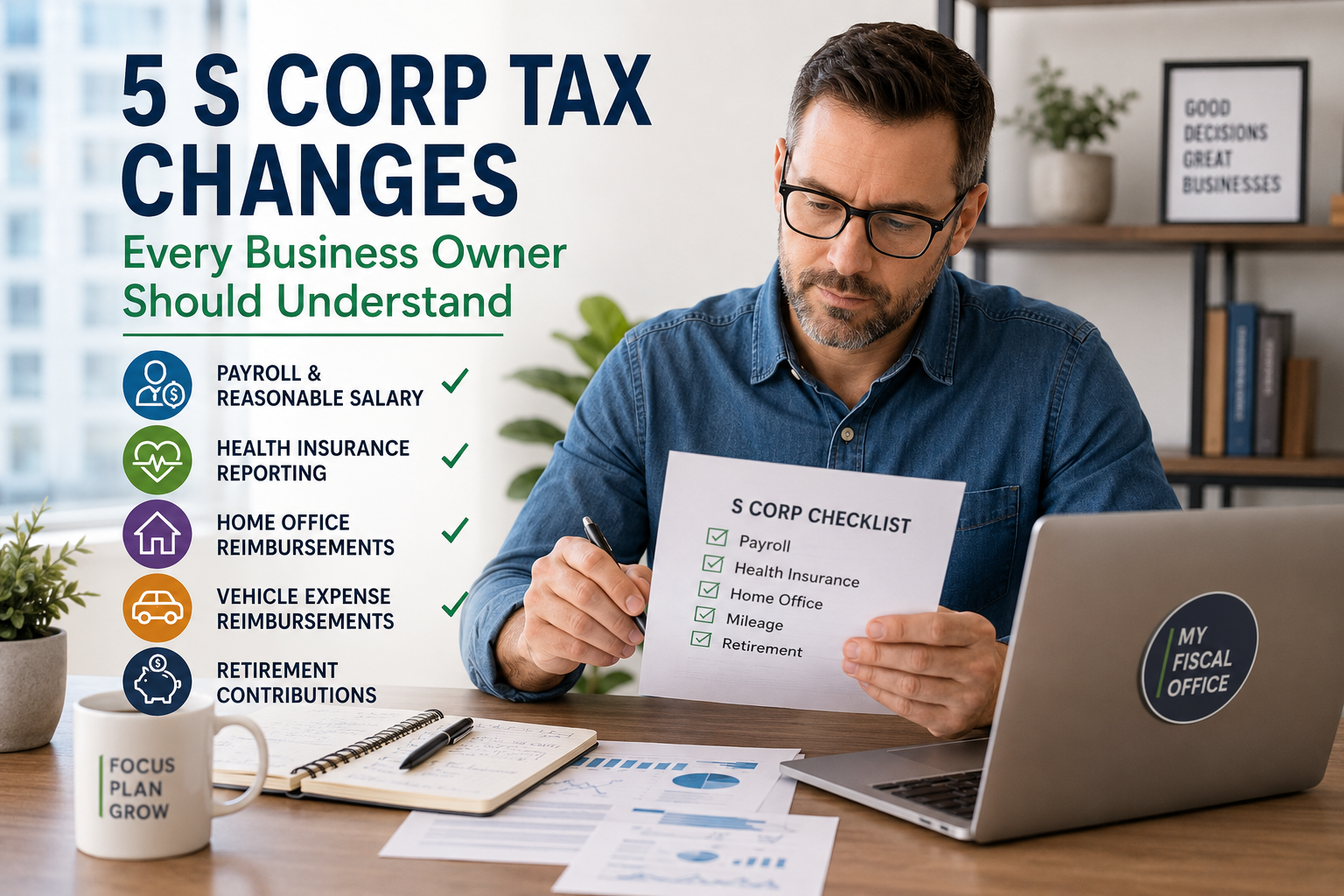
S Corp tax changes are numerous and some are not so obvious.
A few weeks ago, we discussed converting a single-member LLC to an S corporation and why the math can be different for a business operating in New York City. This is the practical follow-up: what actually changes once the S corporation election takes effect?
Electing S corporation status may help the right business owner reduce certain taxes, but the S Corp tax changes do not stop with filing a different business tax return. You also have to change how you pay yourself, handle health insurance, deduct home office costs, reimburse vehicle expenses, and calculate retirement contributions.
Here are five of the biggest changes business owners need to understand.
S Corp Tax Changes Begin With Paying Yourself a Salary
When you operate a single-member LLC taxed as a sole proprietorship, you generally take owner draws whenever you need money from the business.
Those draws do not determine your taxable business income. Your taxable profit is generally based on what the business earned minus its deductible expenses and not how much cash you transferred to your personal account.
That changes once the business is taxed as an S corporation.
An S corporation owner who performs services for the company generally needs to become an employee and receive a reasonable salary through payroll. You may still take shareholder distributions, but you cannot simply replace your entire salary with distributions to avoid Social Security and Medicare taxes.
The IRS does not provide one universal salary percentage that works for every S corporation owner. Instead, reasonable compensation depends on factors such as:
- The work you perform
- The time you spend working in the business
- Your experience and responsibilities
- What comparable businesses pay for similar work
- The company’s size and financial condition
- Whether other employees help perform the work
This is not an area where you want to choose the smallest salary possible and hope nobody notices. If the IRS determines that your salary was unreasonably low, it may reclassify some of your distributions as wages. That can result in additional payroll taxes, penalties, interest, and amended payroll filings. The IRS specifically identifies reasonable compensation as an important issue for shareholder-employees.
The goal should be a salary that is supportable and not artificially high and not artificially low.
S Corp Tax Changes Affect Your Health Insurance
Health insurance is another area that must be handled differently after an S corporation election.
For a shareholder who owns more than 2% of the S corporation, the company should generally either pay the health insurance premiums directly or reimburse the shareholder for premiums the shareholder paid personally.
The premiums must then be properly reported through payroll and on the shareholder’s Form W-2. The amount is generally included in federal taxable wages but is handled differently from ordinary salary for Social Security and Medicare tax purposes when the requirements are met.
The corporation receives a business deduction for the insurance expense. The shareholder may then qualify for the self-employed health insurance deduction on the personal tax return, subject to the applicable rules and limitations.
The important point is that simply paying the premiums personally and handing the total to your tax preparer at year-end may not be enough. The corporation needs to establish or reimburse the coverage, and the amount needs to be reported correctly through payroll.
This is one reason we recommend reviewing shareholder health insurance before the end of the year to ensure you are following these IRS rules. Fixing it before the final payroll is much easier than discovering the problem while preparing the tax return.
S Corp Tax Changes How You Deduct a Home Office
A single-member LLC owner may be able to claim a home office deduction directly on the personal tax return.
Once you become an employee of your S corporation, that approach generally changes. Rather than personally claiming the same deduction, the corporation may reimburse you for qualifying home office expenses under a properly structured accountable plan.
You would provide the company with an expense report showing the business portion of applicable costs, which may include items such as:
- Rent
- Mortgage interest
- Real estate taxes
- Utilities
- Renters or homeowners insurance
- Repairs and maintenance
- Internet costs
- Depreciation, when applicable
The corporation records the qualifying reimbursement as a business expense. When the accountable-plan requirements are followed, the reimbursement generally is not treated as additional taxable wages to the employee.
The normal home office rules still apply. The space must generally be used regularly and exclusively for the business. A kitchen table that is also used for dinner and family activities will usually not qualify as an exclusive business space. Here is a link to the IRS rules home office deduction rules.
You also need a reasonable calculation showing how the reimbursement was determined. The company should not simply transfer an estimated amount every month without supporting records.
A written accountable plan, regular expense reports, and documentation of the calculation can make this process much cleaner.
Vehicle Expenses Usually Become Reimbursements
Vehicle costs work in a similar way to the home office deduction.
When you are an employee of your S corporation and use your personally owned vehicle for company business, the corporation can generally reimburse you for the business use. For many small business owners, the simplest approach is to maintain a mileage log and have the corporation reimburse documented business miles using the applicable mileage rate.
A good mileage log should include:
- The date of the trip
- Your destination
- The business purpose
- The number of business miles driven
Several mileage-tracking apps can help automate this process. The best system is the one you will actually use consistently.
Some owners consider transferring their vehicle into the corporation. That can create complications when the car is also used personally. Personal use of a company-owned vehicle may need to be calculated and included as a taxable fringe benefit on the owner’s W-2.
Unless the vehicle is used almost entirely for business, keeping it personally owned and reimbursing documented business mileage is often the cleaner approach.
That does not mean mileage reimbursement is always best. Businesses with expensive commercial vehicles or unusually high operating costs may get a different result. The decision should be based on the vehicle, its actual use, and the company’s specific numbers.
S Corp Tax Changes Can Affect Retirement Contributions
Retirement contributions are another area where the math changes.
For a sole proprietor, SEP IRA contribution calculations are generally based on adjusted net self-employment earnings.
For an S corporation shareholder, employer retirement contributions are generally based on the shareholder’s W-2 compensation, not the company’s total profit and not shareholder distributions.
That means a shareholder who takes a very low salary may also reduce the amount the company can contribute to a retirement plan on the shareholder’s behalf.
For example, an S corporation generally cannot use $150,000 of business profit as the basis for an employer retirement contribution when the shareholder’s W-2 salary is only $50,000. The applicable calculation will usually begin with the $50,000 of eligible compensation.
This is another reason reasonable compensation should be considered as part of a larger tax-planning conversation. Salary affects more than payroll taxes. It may also affect retirement contributions, borrowing applications, Social Security earnings history, and certain employee benefits.
Be Careful With a SEP IRA When You Hire Employees
A SEP IRA can work well when the owner is the company’s only employee.
However, eligible employees generally must receive the same contribution percentage as the owner. If the company contributes 20% of the owner’s eligible compensation, it may also have to contribute 20% of eligible compensation for participating employees.
That can become expensive as the company grows.
For this reason, we often encourage growing businesses to compare a SEP IRA with a 401(k). A 401(k) may allow the owner to make an employee salary-deferral contribution and may give the business more flexibility in designing employer contributions.
For an owner-only S corporation, a Solo 401(k) may allow both employee and employer contributions, subject to annual limits and compensation rules. Once eligible employees are hired, however, the plan may need to become a traditional company 401(k) and comply with additional participation and testing requirements.
There is no single retirement plan that works best for every business. The right choice depends on payroll, employee demographics, company cash flow, and how much the owner wants to contribute.
S Corp Tax Changes Require Better Recordkeeping
The biggest adjustment for many new S corporation owners is not the tax return. It is the additional structure required throughout the year.
You now need to stay on top of:
- Regular payroll
- Reasonable compensation
- Shareholder distributions
- Health insurance reporting
- Home office expense reports
- Mileage reimbursements
- Retirement-plan calculations
- Separate business and personal spending
An S corporation can offer valuable tax-planning opportunities, but only when it is operated like a separate company.
You cannot treat the corporation as a separate business when that saves taxes and then treat it like your personal checking account the rest of the year.
The paperwork is not there merely to make your life difficult. It creates the records needed to support the deductions and tax treatment you are claiming.
Plan for the Changes Before Electing S Corp Status
An S corporation election should not begin with filing a form and figuring everything else out later.
Before making the election, you should understand:
- What a reasonable salary would be
- How frequently payroll will be processed
- How health insurance will be paid and reported
- Whether the company needs an accountable plan
- How vehicle expenses will be reimbursed
- Whether the existing retirement plan still makes sense
- How the election affects state and local taxes
This is especially important in New York City. New York City does not recognize the federal S corporation election in the same way as federal and New York State tax law, so the local business tax can materially change the expected savings.
We love being in NYC, but running a business here can be complicated. We know because we also run a business here.
The goal is not simply to elect S corporation status. The goal is to make sure the election improves your overall tax position without creating avoidable payroll, reporting, or compliance problems.
Considering an S Corporation Election?
If your business has grown and you are considering S corporation status, we can help you look beyond the basic tax calculation.
We will review the likely tax savings, New York City business tax, reasonable compensation, payroll, health insurance, reimbursements, and retirement-plan considerations so you understand what will actually change.